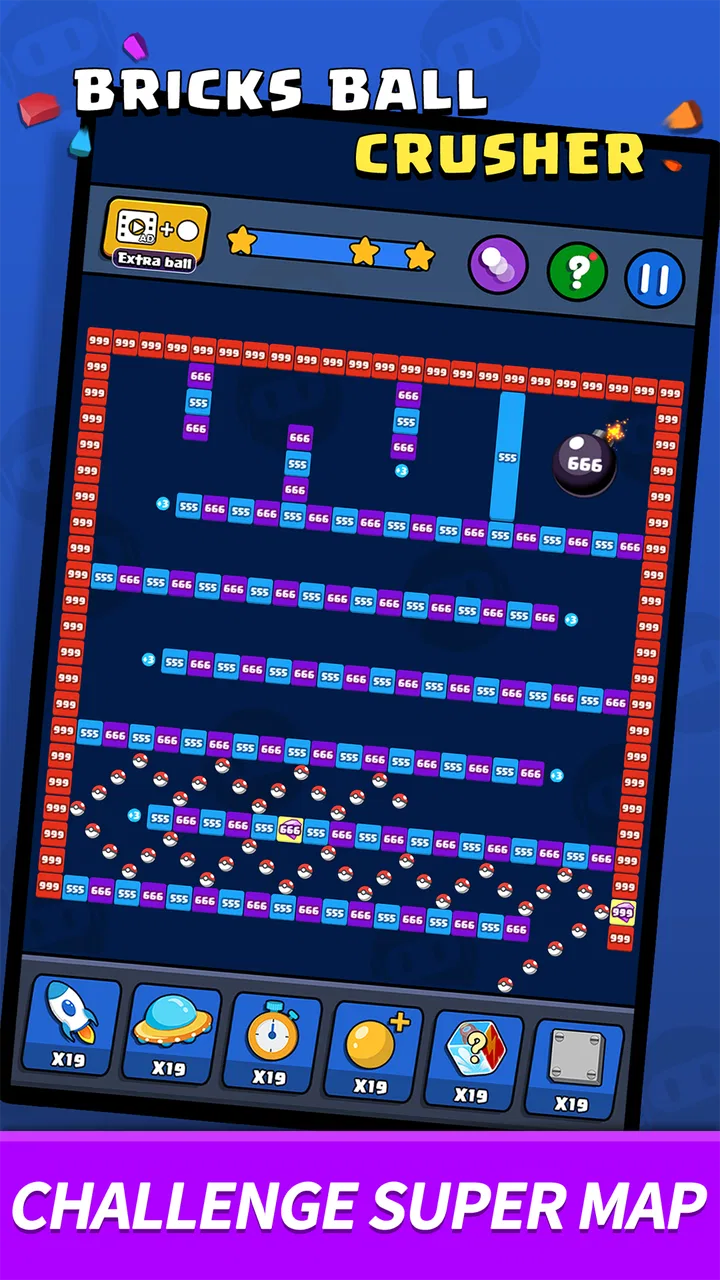
Bricks Ball Crusher
- 4.5
- Rating
- 10.00M
- Installs
- Free
- Price

 Analysis by App-foxy
I went into Bricks Ball Crusher expecting a simple brick-breaking game, and that is exactly what it gives you: a clear shot, a satisfying burst of blocks, a result to react to, and an immediate reason to try again. It is an arcade game from PoseidonJoy, available for free, with a Everyone age rating. The idea is easy to understand within seconds, but the better experience comes from learning how to aim rather than simply tapping as quickly as possible.
The first thing I noticed is how little preparation the game asks from me. There is no complicated control scheme to memorize before the action begins. I focus on the angle, release the shot, and watch the ball travel through the arrangement of bricks. That directness makes it suitable for a short break, but it also gives the game enough room for careful play. A careless angle can leave too many blocks in awkward positions, while a well-planned shot can keep moving through several targets before returning.
How the brick-breaking loop feels in actual play
I found that the most useful way to judge each turn is to think beyond the first impact: a shot can look strong yet leave the next board awkward, while a modest hit may open a cleaner route. That makes the loop feel like a series of small decisions rather than a race, and it sets up a closer look at how aiming shapes the experience.
You May Also Like

 Blood Strike: 2.5 Anniversary
Blood Strike’s Loadouts Turn Every Drop Into a Tactical Gamble
A close look at Blood Strike’s custom loadouts: how fast access to signature weapons reshapes its battle royale rhythm, rewards preparation, and narrows the gap between fights.

 Pandora - Music & Podcasts
Pandora’s Music Is Easy to Start, but Harder to Recover
Pandora’s strength is its low-effort path from a seed to a station. Its weak spot is how much confidence it asks you to place in connection, setup, and quiet recovery.

 8 Ball Pool
 Is Built on Rivalries, Rematches, and Routine
A close look at the rivalries, rematches, shared routines, and unanswered safety questions that turn a quick pool match into a persistent mobile community.

 Samsung Music
’s Quiet Strength Is Playing What You Already Own
Its reach comes less from spectacle than from dependable access to a personal library. That simplicity is both the app’s strongest retention engine and its ceiling.

 AccuWeather: Weather Radar
AccuWeather Review: A Quick, Clear Forecast for Everyday Decisions
For everyday plans, the best forecast is the one you can understand quickly. AccuWeather makes rain timing, radar, and local conditions easy to act on, with a few trade-offs.

 Hill Climb Racing
Why Hill Climb Racing Still Turns Crashes Into One More Run
A tiny car, a bumpy hill and one more upgrade: Hill Climb Racing keeps resurfacing because its simple chaos makes every near-miss feel personal.
More From Our News Desk



The first action is simple, but the angle matters
The core move is familiar: I aim and send balls toward numbered bricks, trying to reduce the structure before it reaches the bottom. The controls are approachable because the game communicates its main idea visually. I do not need a tutorial-heavy introduction to understand what a useful shot looks like. The challenge starts when I have to decide whether to attack the largest number, clear a dangerous position, or search for a bounce that reaches several areas.
That decision is where the game becomes more than a casual tapper. A straight shot at the nearest brick may feel productive, yet it can be less valuable than sending the ball toward a side wall and creating a longer path. I often found myself looking for angles that would make the ball return through the same area from a different direction. The best shots are not always the most obvious ones, and that small layer of planning gives each board a little personality.
The controls are also well suited to touchscreens because the action remains focused on one gesture. I can play while standing in a queue or sitting on public transport without needing a long uninterrupted setup. At the same time, the simplicity means precision matters. If I rush the aim, the mistake is mine rather than the control system’s, which makes a failed turn feel understandable even when it is frustrating.
Feedback arrives in a steady rhythm
Once the shot is released, the game gives me a quick visual explanation of whether the plan worked. Bricks break, the ball continues along its path, and the remaining layout shows what still needs attention. This creates a useful rhythm: action first, then observation. I am not merely waiting for a score to appear; I am watching the consequences of the angle I chose.
That feedback is especially important when a ball reaches multiple bricks. A single launch can produce a chain of small successes, and the repeated impacts make the result feel more substantial than the initial gesture. When the path is inefficient, the same rhythm exposes the problem immediately. The ball may return after doing less damage than expected, leaving a board that is harder to manage on the next turn.
I like that the game’s feedback encourages adjustment instead of demanding constant speed. The useful question after a turn is not only “How many bricks did I break?” but also “Why did that path work or fail?” Players who enjoy light spatial reasoning will get more from it than people who want an arcade game based entirely on rapid reactions.
Small rewards keep another turn tempting
The reward is built into the destruction itself. Breaking bricks gives me a visible sense of progress, while a strong angle can turn one modest launch into a much more satisfying clear-out. This is a good fit for short sessions because the game does not need a long story or a large objective to make a turn feel complete. The immediate result is the motivation.
There is also a practical reward in improving my own choices. Early attempts can feel mechanical, but after a while I start noticing useful bounce opportunities and dangerous formations more quickly. The game rewards patience indirectly: taking a moment to line up a better shot often produces a better board afterward. That makes the experience feel less random than it may seem during the first few rounds.
Still, the reward structure has a limit. If I am looking for character development, a narrative campaign, or a deep competitive system, this is not the right kind of arcade game. Its pleasure comes from the shot-and-result cycle, not from collecting a complex identity or building a long-term world. I would recommend it to someone who enjoys small improvements and repeated attempts, rather than to someone who needs every session to introduce a major new idea.
The reset is what makes the next session easy to start
After a poor turn or a finished run, the game’s greatest convenience is that I can reset mentally very quickly. I do not have to remember a complicated plot or reconstruct a large strategy. I simply look at the next arrangement and begin making decisions again. That low restart cost is a major reason I can see myself opening it repeatedly during spare moments.
A realistic example is a short lunch break. I can play one attempt while waiting for food, stop when the break ends, and return later without feeling that I abandoned an important task. The same quality works well for people who want a game that can be paused between everyday responsibilities. It is less suitable for a player who prefers long, uninterrupted runs with a strong sense of progression from one chapter to the next.
The reset also softens failure. A bad angle may ruin the current position, but it does not make me study a complicated loss screen or spend time rebuilding a strategy tree. I can try again with one clear lesson in mind: use a different bounce, remove a more threatening brick, or avoid leaving the lower area crowded. That is a good design choice for a casual arcade title, although repeated resets can feel routine if I play for too long in one sitting.
What separates it from ordinary brick-breaker alternatives
Compared with a classic paddle-and-ball brick breaker, this game puts more emphasis on planning the launch angle than on moving a paddle at the bottom. That changes the mood completely. Traditional versions test reflexes and positioning in real time, while this style gives me a moment to think before the action unfolds. If you prefer direct control over the ball’s movement, a paddle-based alternative may feel more active. If you prefer predicting a path and then watching the result, this game is the better match.
It also differs from many fast arcade games because the meaningful decision happens before the animation finishes. I am not constantly reacting to enemies or obstacles. Instead, I am arranging the conditions for a good chain of impacts. That makes it approachable for players who like puzzles but do not want a fully turn-based experience.
The trade-off is that the loop can become repetitive. The same basic action remains central throughout play, so variety depends heavily on the layouts and on how creatively I approach them. Anyone wanting frequent changes in mechanics should look elsewhere. For me, the repetition works in short bursts, but I would not treat it as a substitute for a larger arcade collection.
Useful habits I developed while playing
My most useful habit was to stop aiming only at the brick with the largest visible number. A high-value target can be attractive, but clearing a lower brick that blocks a productive route may be more important. I began judging each shot by the path it created for the next turn, not just by the damage it caused immediately. That small change made the game feel more strategic without making it complicated.
I also learned to value side-wall bounces when the layout allowed them. A direct line may hit one area and end quickly, while a carefully chosen angle can send the ball across several rows. This is not a guaranteed solution for every board, but it is a useful way to look beyond the nearest target. The practical tip is to imagine where the ball will return, not only where it will go first.
Another helpful approach is to use the end of a turn as information. If the ball comes back with the lower section still crowded, I know the next shot needs to create space rather than chase a tempting upper target. Treating each launch as a small experiment makes failure more useful. I found that mindset more rewarding than trying to play every turn perfectly.
These habits also reveal the game’s main weakness: the depth is narrow. There is room for better decisions, but not an endless range of strategies. Once I understood the strongest angles for a particular arrangement, the satisfaction came from execution and adaptation rather than discovering a completely new system.
Free access and the practical trade-offs
The game is free to download and play, which makes trying it straightforward. It includes in-app purchases ranging from ninety-nine cents to ninety-nine dollars and ninety-nine cents per item. That price range is worth keeping in mind before spending, especially if you are the kind of player who can be tempted by convenience during repeated attempts.
I would approach the purchase system with a simple rule: enjoy the basic loop first and decide later whether any optional spending genuinely improves your experience. The game’s central appeal is already present in aiming, watching the chain of impacts, and resetting for another try. If that loop does not hold your attention without spending, a purchase is unlikely to solve the underlying problem.
For families, the Everyone rating makes the game easier to consider as a broadly accessible arcade option. Even so, younger players may need guidance around optional purchases, as with any free game that offers paid items. The controls are simple enough for beginners, but getting consistently good results still requires patience and an understanding of angles.
Device support and version context
Bricks Ball Crusher supports Android devices running version 7.0 or later, so compatibility should be checked against the phone or tablet you plan to use. The current version is 1.4.51. I would not choose a device solely for this game, but those details are useful if you are installing it on an older Android handset or sharing a device with family members.
The game has been available since August 16, 2018, and its long presence is reflected in its broad audience. It has passed ten million installs, with an average rating of 4.5 from around 587 thousand ratings and about 58 thousand written reviews. Those figures do not replace personal taste, but they do suggest that the straightforward brick-breaking formula has connected with many players.
PoseidonJoy keeps the identity of the game focused on its arcade purpose rather than presenting it as a large, complicated production. That is helpful when I want to know what I am opening: a quick game built around repeated shots, visible outcomes, and gradual improvement. It also means expectations should stay realistic. This is not trying to be a console-style adventure or a rich puzzle campaign.
Who should play it, and who should skip it
I would recommend it to someone who likes games that explain themselves quickly but still reward a little thought. It works particularly well for short breaks, casual sessions, and players who enjoy watching a carefully planned action unfold. It is also a good choice if traditional paddle brick breakers feel too reflex-heavy and you would rather control the initial angle than chase the ball continuously.
I would be more cautious about recommending it to players who need a strong story, multiplayer competition, deep customization, or constant mechanical variety. The game’s strength is its repeatable loop, and that is exactly what may turn into its biggest weakness for people who become bored with repetition. It is also not ideal if you dislike restarting after a failed attempt or prefer games where every session develops a persistent character or world.
For younger players, the accessible controls and Everyone rating are appealing, but an adult may still want to keep an eye on optional purchases. For older casual players, the lack of complicated controls can be a benefit. For dedicated arcade fans, the question is whether the angle-based brick clearing offers enough depth after the initial novelty fades.
The loop verdict after repeated sessions
The complete cycle is easy to describe: I choose an angle, release the shot, watch the impacts, read the new board, and decide whether another attempt can improve the situation. The action is immediate, the feedback is visible, the reward is a satisfying chain of broken bricks, and the reset is quick enough to remove most friction. That structure explains why one short session can naturally become another.
My honest view is that Bricks Ball Crusher succeeds because it does not hide its purpose. It is a focused arcade game, not a broad entertainment package. The best moments come from finding a smart bounce and seeing the ball turn one decision into a longer sequence of destruction. The weaker moments arrive when the repeated format stops offering enough novelty.
With a 4.5 average and more than ten million installs, it is clearly a well-established choice for this kind of casual play. I would still judge it by the loop rather than by its popularity: try it if you enjoy planning simple shots, immediate feedback, and low-pressure restarts. Skip it if you need a story, a large selection of mechanics, or a session that feels different every time.
For me, it works best as a dependable spare-minute game. I can open it without preparation, make one meaningful decision, see the result, and either stop or take another shot while the lesson is still fresh. That is a modest goal, but the game meets it well. If you want a free arcade experience built around angle, consequence, and one-more-try momentum, this is a sensible download.
FAQs for Bricks Ball Crusher
01What is the main objective of Bricks Ball Crusher?
Bricks Ball Crusher is a casual mobile game where the primary objective is to break bricks using a ball. Players aim to clear all the bricks on the screen by strategically launching balls at them. The game requires strategic aiming and timing to ensure all bricks are cleared before running out of balls.
02Is Bricks Ball Crusher free to play?
Yes, Bricks Ball Crusher is free to download and play. However, it offers in-app purchases that can enhance the gaming experience. These purchases may include additional balls, power-ups, or removing ads. While the game is enjoyable without spending money, these options can help advance quicker.
03What are the system requirements for Bricks Ball Crusher?
For Android users, Bricks Ball Crusher requires Android 4.1 and up. iOS users need iOS 9.0 or later. These requirements ensure optimal performance and compatibility. Make sure your device meets these specifications to enjoy a smooth gaming experience without crashes or lag.
04Are there any multiplayer features in Bricks Ball Crusher?
Bricks Ball Crusher is primarily a single-player game. It focuses on individual skill and strategy rather than multiplayer interaction. However, players can compete on leaderboards and share their scores with friends, adding a social element to the gameplay.
05Does Bricks Ball Crusher offer any offline play options?
Yes, Bricks Ball Crusher can be played offline, making it a great option for users without constant internet access. Players can enjoy the game without needing a data connection, although some features like leaderboards or in-app purchases may require online access.
Pros
- Addictive gameplay with endless levels.
- Smooth controls enhance user experience.
- Regular updates with new challenges.
- Visually appealing graphics and effects.
- Free to play with optional in-game purchases.
Cons
- Frequent ads can disrupt gameplay.
- Some levels feel repetitive over time.
- In-app purchases can become costly.
- Requires stable internet connection.
- Occasional bugs in latest updates.

Bricks Ball Crusher
Gallery